Kauai Helicopter Tours over Waimea Canyon
A road trip up Route 550 shows you four or five lookouts. A helicopter shows you the back of the gorge, the trail-less waterfalls and the Nā Pali cliffs that only open up from the air. Here is how to pick the right flight.
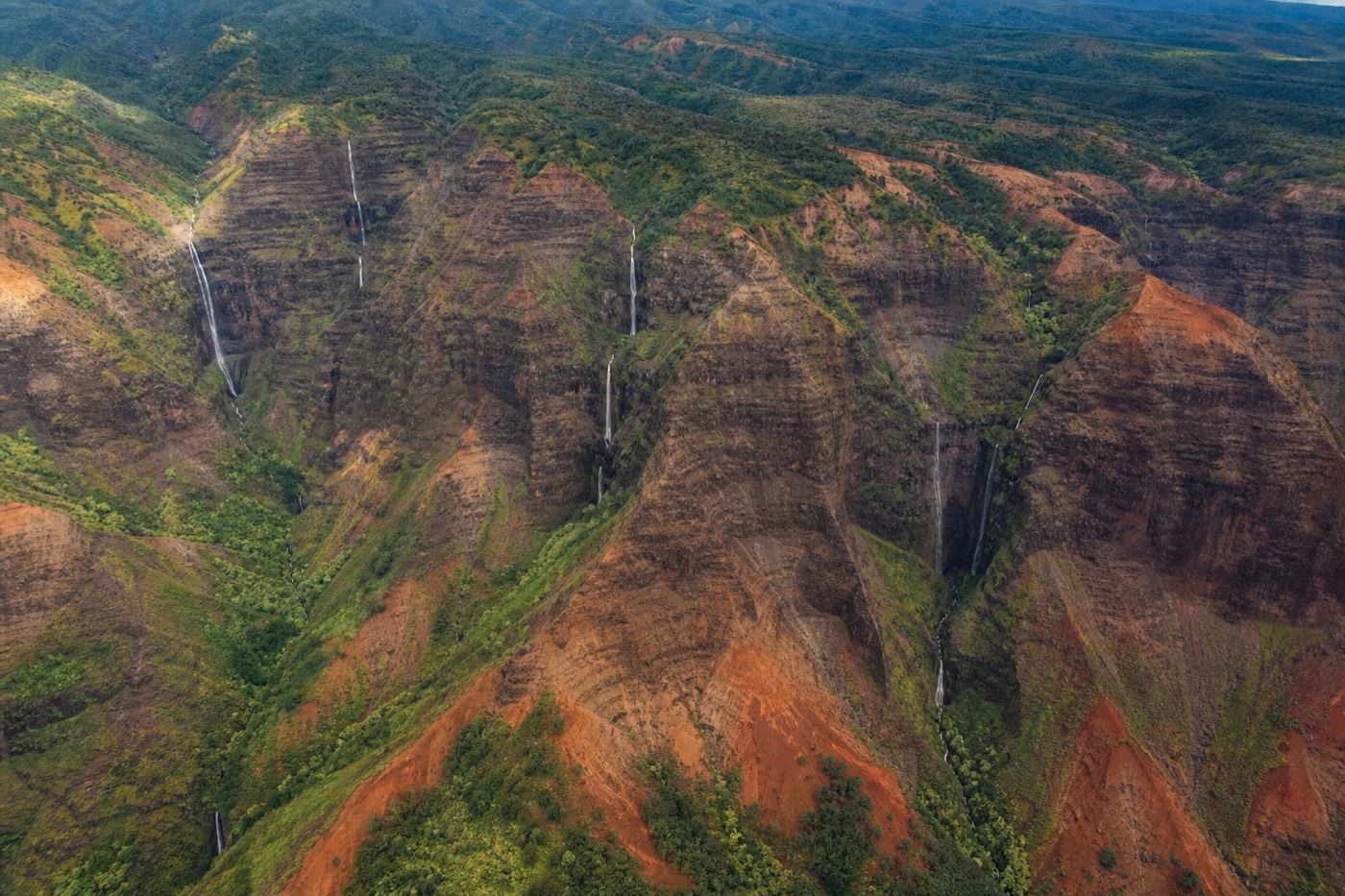
The drive up to Waimea Canyon takes about an hour and delivers a handful of paved lookouts. A helicopter reaches the parts the road never touches: the head of the gorge, the waterfalls with no trailhead, and the fluted emerald walls of the Nā Pali Coast that reveal themselves only from the sea or the sky. Most flights lift off from Lihue Airport, loop a large slice of Kauai in roughly an hour, and treat the canyon as the centerpiece of the ride.
Booking choice: See Waipoʻo Falls, Waimea Canyon and Nā Pali from a private doors-off helicopter. Explore Private Doors-Off Waterfall Flight
Kauai earns the "helicopter island" reputation for a plain reason. Somewhere near 70 percent of it has no road, so the interior waterfalls, the crater walls of Mount Waiʻaleʻale and the sea cliffs of the northwest coast are effectively invisible from the ground. From a seat at 1,500 to 4,000 feet, the whole thing joins up.
This guide covers the two air tours this guide compares over this corner of the island, how doors-on and doors-off flights differ, exactly what passes your window, and the practical stuff that decides whether the hour is a highlight or a disappointment: time of day, seating, motion sickness, weather and price. If you already know you want the calmer, cheaper airplane instead, skip ahead to our companion scenic air tours guide.
Which Helicopter Tour Over Waimea Canyon Should You Pick?
The current private doors-off listing is for two or three passengers, with a minimum age of seven and strict individual and combined weight limits. It is not the former four-passenger Hughes 500 offer. Seating is assigned for aircraft balance; confirm the current aircraft and seat arrangements before booking.
The current private doors-off listing is for two or three passengers, with a minimum age of seven and strict individual and combined weight limits. It is not the former four-passenger Hughes 500 offer. Seating is assigned for aircraft balance; confirm the current aircraft and seat arrangements before booking.
The short version: the helicopter gets lower and closer, the airplane costs less and rides smoother. If you are torn between the two aircraft, our fixed-wing scenic air tour guide lays out the airplane side in full, and the section further down compares them directly.
| Flight | Aircraft | Seats | Doors | Time aloft | From (check live listing) | Rating |
|---|---|---|---|---|---|---|
| Doors-off helicopter | The current private doors-off listing is for two or three passengers, with a minimum age of seven and strict individual and combined weight limits. It is not the former four-passenger Hughes 500 offer. Seating is assigned for aircraft balance; confirm the current aircraft and seat arrangements before booking. | 4 | Removed | ~60 min | Check current quote | 5.0 (traveler reviews on the provider listing) |
| Fixed-wing scenic air | G8 AirVan, high wing | 6 | On | 65 to 70 min | Check current quote | 4.9 (traveler reviews on the provider listing) |
Prices move with season and demand, so treat those figures as a starting point and confirm the current number on the operator's live listing before you book.
Doors-on Vs Doors-off: Which Helicopter Is Right For You?
Doors-off wins for photography and adrenaline: no glass between your lens and the canyon, and a real sense of the drop. Doors-on wins for comfort: a warmer, calmer, enclosed cabin with far less wind. Cold-sensitive travelers, nervous first-timers and younger kids are usually happier with the doors on.
The current private doors-off listing is for two or three passengers, with a minimum age of seven and strict individual and combined weight limits. It is not the former four-passenger Hughes 500 offer. Seating is assigned for aircraft balance; confirm the current aircraft and seat arrangements before booking.
What you gain is a clean line of sight. Shooting through a curved window adds glare and reflections that fight you in bright canyon light; an open doorway removes the problem entirely. Photographers and anyone chasing the biggest thrill lean doors-off. If you want more detail on whether the premium pays off, our breakdown of whether doors-off is worth the extra money runs the numbers and the packing list.
| What matters | Doors-off | Doors-on |
|---|---|---|
| Photos | No glass, no glare, clean shots | Shoot through the window, some reflection |
| Wind and cold | Strong wind, cold at altitude | Calm, warm, enclosed |
| Intensity | Exposed, bigger rush | Relaxed and contained |
| Loose items | Everything strapped or stowed, phone on a lanyard | More forgiving, still secure your gear |
| Best for | Photographers, thrill-seekers | Nervous flyers, cold-sensitive travelers, kids |
What Do You Actually See From The Air?
A loop out of Lihue strings together the sights Kauai keeps hidden from the road: the full length of Waimea Canyon, Waipoʻo Falls dropping into the gorge, the Jurassic Park waterfall in a private valley, the crater walls of Mount Waiʻaleʻale and the sea cliffs of the Nā Pali Coast. Most of it has no trail and no pullout.
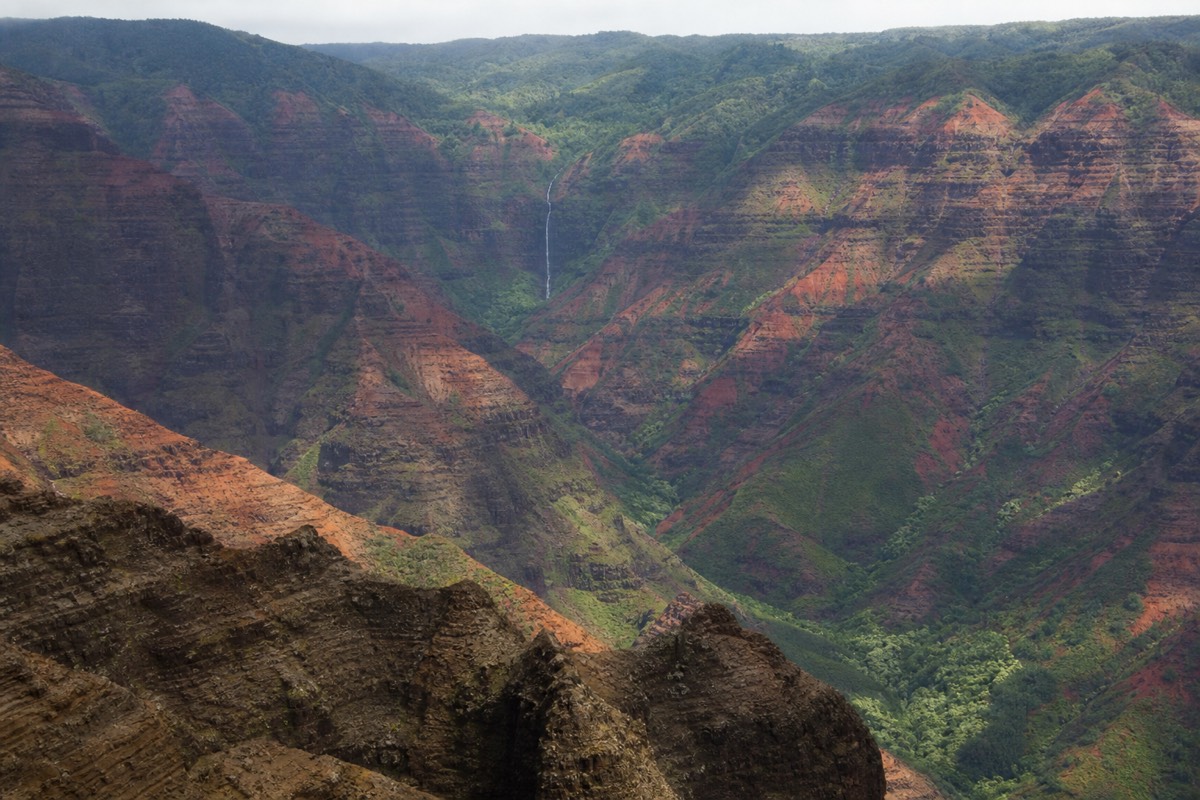
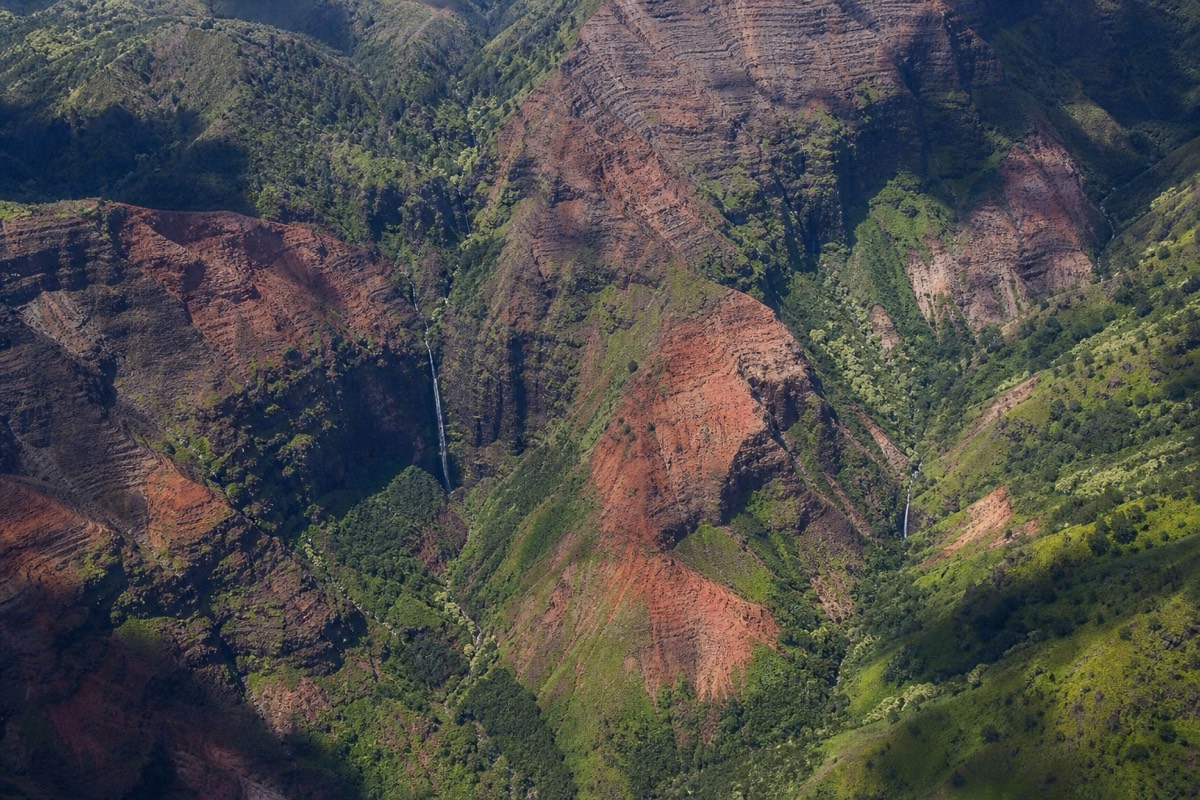
From the rim, Waimea Canyon reads as a single wide view. From the air it reads as a system: about fourteen miles of red-and-green walls that fall three to four thousand feet to a thin silver river, with side canyons branching off in every direction. The layered lava that took millions of years to stack up is easy to trace when you are level with it rather than peering down from a fence.
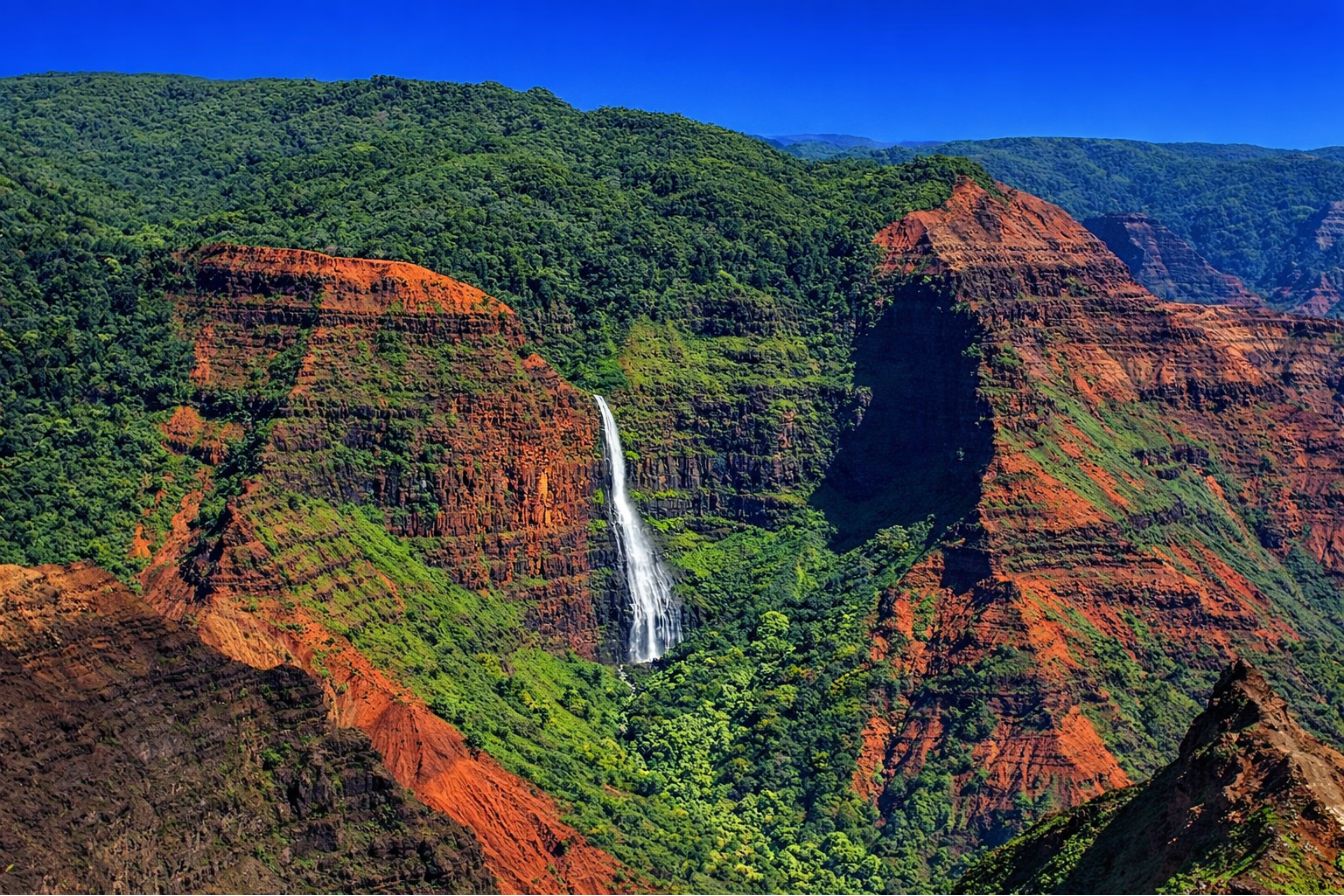
The waterfalls are the part a road trip cannot match. Waipoʻo Falls, the canyon's best-known cascade, usually asks for a hike from the Canyon Trail; from a helicopter it slides past your window with no effort. Deeper in, most Lihue flights swing over Manawaiopuna Falls, the ribbon made famous as the "Jurassic Park" waterfall, tucked in a valley with no public access at all. If waterfalls are your priority, our Waipoʻo Falls trail guide covers the walk-in version for comparison.
Then the ship turns for the coast. The Nā Pali cliffs rise thousands of feet straight out of the Pacific in a run of fluted green pinnacles, and weather permitting the pilot points out the crater below Mount Waiʻaleʻale, one of the wettest spots on Earth, streaked with the thin waterfalls locals call the Walls of Tears. Winter flights sometimes catch humpback whales offshore. The same coastline is spectacular from sea level too, which is why many travelers pair the sky with our Nā Pali Coast boat tours.
| Landmark | What it is | Why it lands from the air |
|---|---|---|
| Waimea Canyon | ~14 mi long, 3,500 to 4,000 ft deep, the "Grand Canyon of the Pacific" | You see the whole gorge and its side canyons at once |
| Waipoʻo Falls | The canyon's signature waterfall | No hike needed, it passes right by the cabin |
| Manawaiopuna Falls | The "Jurassic Park" waterfall | Sits in a private valley with no public trail |
| Nā Pali Coast | Fluted sea cliffs on the northwest shore | The pinnacles only fully open up from sea or sky |
| Mount Waiʻaleʻale | Crater and "Walls of Tears" waterfalls | Roadless interior, visible only from the air |
| Hanalei and Hanapepe valleys | Green river valleys and taro fields | Ties the coast back to the canyon on the loop |
Helicopter Vs Fixed-wing Scenic Flight: What Is The Real Difference?
A helicopter can slow down, bank tight and follow a route chosen by the pilot; that closeness is its whole appeal, and it costs more. A fixed-wing airplane rides higher and smoother in gentle turns, which suits nervous flyers and thinner budgets. Same landmarks, different feel and a price gap of a couple hundred dollars per seat.
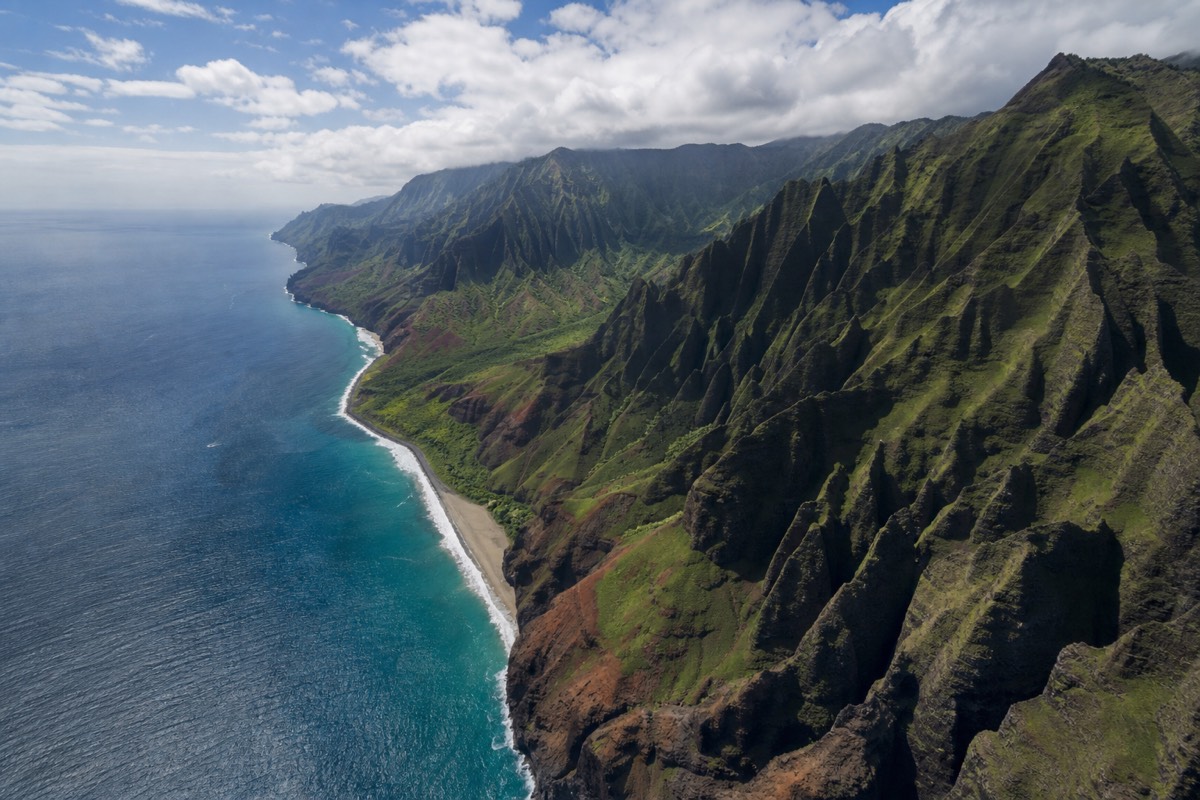
Both aircraft show you the canyon, the coast and Waiʻaleʻale, so the choice is about how you want to see them. The helicopter is the closer, more dynamic ride: it can hold position, tilt into a valley and put a waterfall almost at eye level. That maneuverability is also why it moves more in the air and why the seat costs more. The high-wing airplane trades some of that intimacy for a steadier platform, more seats and a friendlier price.
If you are still weighing aircraft, the full side-by-side lives in our helicopter vs fixed-wing comparison, and travelers deciding between the air and the water often read our boat tour vs helicopter breakdown first.
| Feature | Helicopter | Fixed-wing airplane |
|---|---|---|
| Movement | Banks tight, slows, drops low | Steady, gentle turns, higher |
| Closeness to the walls | Very close, near eye level | Wide, high angle, clear down-views |
| Ride comfort | More motion | Smoother, calmer |
| Typical from-price | Check current quote | Check current quote |
| Best for | Photographers, close-ups, thrill | Value, nervous flyers, families |
What Is The Best Time Of Day To Fly?
Book the earliest flight you can stand. Kauai's trade winds are calmest and the canyon air is clearest in the morning; by early afternoon clouds and mist build over the rim and the Nā Pali lookouts, which blocks views and roughens the ride. The same timing rule that governs the drive up Route 550 governs the sky.
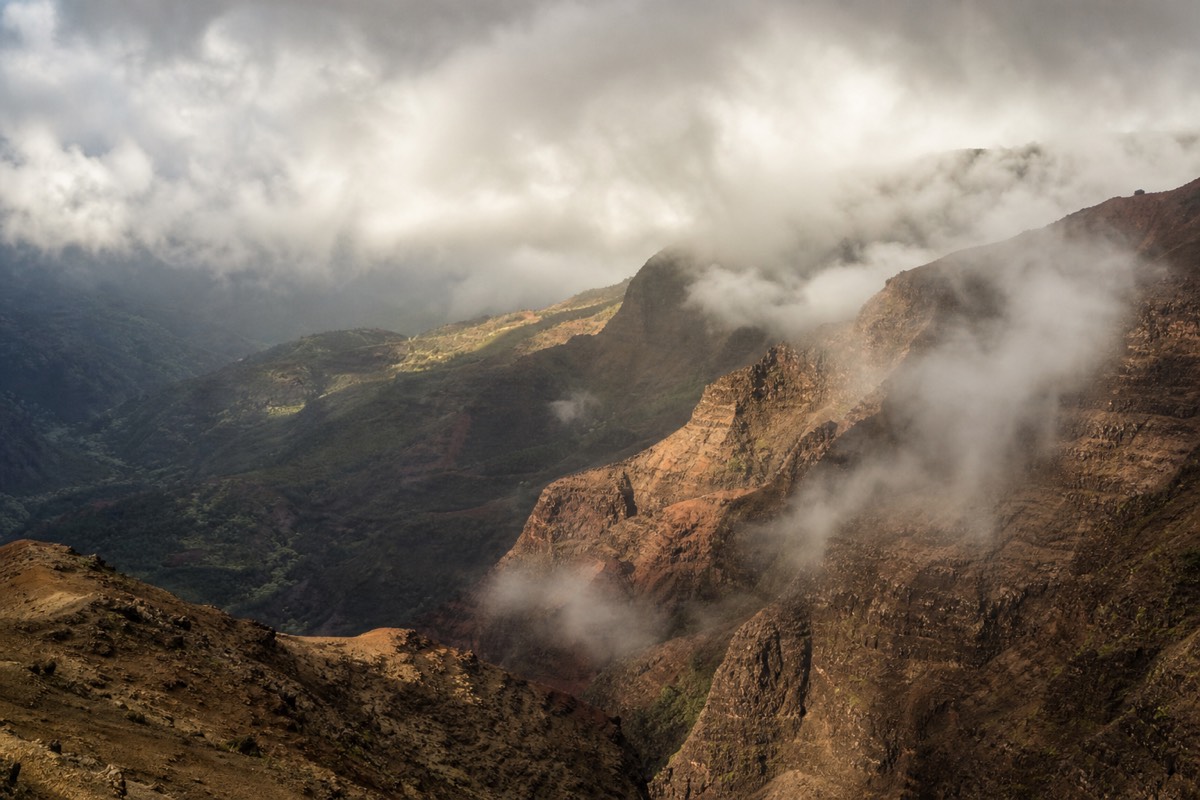
Morning air over the canyon is usually smoother, the light rakes across the red walls at a flattering angle, and the summits are more likely to be clear. As the ground heats through the day, updrafts and cloud pile onto the high country, so a late flight can mean a bumpier ride and a gray wall where Waiʻaleʻale should be. This is the single most useful timing decision you make, and it mirrors the advice in our best time to visit Waimea Canyon guide and the shorter best time of day breakdown.
| Departure window | Air | Light | Cloud risk over the rim | Verdict |
|---|---|---|---|---|
| First flights (early AM) | Calmest | Warm, low-angle | Low | Best overall |
| Late morning | Still good | Bright, even | Building | Solid backup |
| Midday | Choppier | Flat, high sun | Moderate to high | Hit or miss |
| Afternoon | Bumpiest | Fading | High | Views often blocked |
Which Side Of The Helicopter Has The Best Views?
The current private doors-off listing is for two or three passengers, with a minimum age of seven and strict individual and combined weight limits. It is not the former four-passenger Hughes 500 offer. Seating is assigned for aircraft balance; confirm the current aircraft and seat arrangements before booking.
The current private doors-off listing is for two or three passengers, with a minimum age of seven and strict individual and combined weight limits. It is not the former four-passenger Hughes 500 offer. Seating is assigned for aircraft balance; confirm the current aircraft and seat arrangements before booking.
The current private doors-off listing is for two or three passengers, with a minimum age of seven and strict individual and combined weight limits. It is not the former four-passenger Hughes 500 offer. Seating is assigned for aircraft balance; confirm the current aircraft and seat arrangements before booking.
Will You Get Motion Sick On A Scenic Flight?
Motion comfort varies with the traveler, aircraft or vessel and conditions. Ask a pharmacist or clinician about any motion-sickness medicine and its timing; do not assume an early departure prevents symptoms.
Air over the tropics gets more turbulent as the day warms, so the morning-flight advice does double duty: better views and a gentler stomach. The helicopter's ability to bank and hover is thrilling but adds movement, while the fixed-wing airplane's steadier turns are easier on sensitive travelers, one more reason nervous flyers gravitate to the airplane covered in our scenic air tours guide.
Motion comfort varies with the traveler, aircraft or vessel and conditions. Ask a pharmacist or clinician about any motion-sickness medicine and its timing; do not assume an early departure prevents symptoms.
| Do this | Why it helps |
|---|---|
| Book an early flight | Conditions vary on the day |
| Eat a light meal first | Neither empty nor overfull settles best |
| Motion comfort varies with the traveler, aircraft or vessel and conditions. Ask a pharmacist or clinician about any motion-sickness medicine and its timing; do not assume an early departure prevents symptoms. | Gets ahead of nausea rather than chasing it |
| Watch the horizon, not a screen | Keeps your eyes and inner ear in agreement |
| Go easy on alcohol the night before | Dehydration makes motion sickness worse |
| Ask for a forward-facing seat | Feels steadier than side or rear seats |
What Happens If Weather Cancels Your Flight?
Air tours are weather-dependent, and reputable operators will not launch into unsafe conditions. If they scrub the flight, you are normally rebooked for a clearer slot or refunded under the listing's policy. Book your flight early in your trip so a weather day still leaves room to try again before you fly home.
Kauai's weather is famously local: the coast can be sunny while the canyon rim sits under cloud. Pilots make the call on the day, and a cancellation is a safety feature, not a letdown. The practical move is scheduling: put the flight near the start of your stay so a rescheduled tour has somewhere to go.
Read the cancellation and refund terms on the operator's live listing before you pay, and look for a free-cancellation window in case your own plans shift. Because the same weather that grounds a flight also blankets the drive-up lookouts, a cloudy morning is worth watching closely across the whole west side, a point our cloudy-lookout guide digs into.
How Much Do Kauai Helicopter Tours Cost?
Use current provider quotes for your dates and party. The airplane lists a 65-minute flight; the private doors-off itinerary is about 75 minutes with a 45-minute check-in and a two-person minimum. The calculator below compares whole-party totals without assuming a fixed price gap.
Helicopter pricing is not one number. A doors-off, private-feel flight in a small turbine ship sits at the top of the range for a reason: fewer seats, open doors, premium photography. A larger shared cabin, or the fixed-wing airplane, spreads the cost across more passengers and lands lower. Flight length matters too, and a longer route over more of the island costs more than a quick loop.
Season is the other lever. Winter brings whale-watching demand and busier dates, which firms up prices, while shoulder months and early booking tend to open better rates. Always confirm the live figure on the operator's official listing, since that is where current pricing, hotel-pickup details and free-cancellation windows are shown.
| Factor | Pushes price up | Pushes price down |
|---|---|---|
| Doors | Doors-off | Doors-on or fixed-wing |
| Cabin | Small, private feel | Larger shared cabin |
| Flight length | Longer island loop | Shorter canyon-and-coast loop |
| Season | Winter and holidays | Shoulder months |
| Timing | Last-minute | Booked well ahead |
Is A Kauai Helicopter Tour Worth It?
For most first-time visitors, yes. A single hour reaches the roughly 70 percent of Kauai with no road, including waterfalls, the Nā Pali cliffs and the crater of Waiʻaleʻale that you simply cannot see any other way. If budget is tight or heights unsettle you, the fixed-wing airplane delivers most of the same views for far less.
The honest test is what you value. If you want the single most complete view of the island and you have a photographer's eye, the doors-off helicopter is hard to beat and the reviews reflect it. If you would rather spend the money on days in the water or on the ground, an airplane flight or a boat trip along the coast covers a lot of the same wonder. Travelers weighing where to spend often start with our overview of boat versus helicopter.
What the flight is not is a substitute for standing on the rim. The drive up Route 550 and a proper scenic air tour answer different questions, and many visitors book both. If you only do one air option, match it to how you feel about open doors and cost.
Advice For First-timers, Seniors And Kids
First-timers should book early, dress in layers and keep the camera on a strap. Seniors and anyone cautious about heights are usually more comfortable in a doors-on cabin or the fixed-wing airplane. Kids can fly on most tours subject to age and weight rules, so check the operator's minimums before you count on it.
For a first flight, the biggest wins are timing and clothing. Go early for smooth air and clear summits, and pack a light layer, because the cabin cools as you climb toward the 4,000-foot rim, more so with the doors off. Secure every loose item and put your phone on a lanyard so a great shot does not become a lost device.
- Seniors and non-hikers: a flight is one of the easiest ways to experience the canyon with no walking at all, and a doors-on or fixed-wing seat keeps it gentle. Our Waimea Canyon for seniors and non-hikers guide pairs well with an air tour.
- Families with kids: most operators set a minimum age and a minimum weight for a paid seat, and some do not allow infants on doors-off flights for safety. Confirm the rules on the listing, and see our Waimea Canyon with kids guide for the rest of a family day out west.
- Nervous flyers: choose the fixed-wing airplane or a doors-on helicopter, sit forward if you can, and read the helicopter vs fixed-wing comparison before you decide.
Book the right flight for how you travel and Kauai from above becomes the highlight of the trip. A well-planned Waimea Canyon Tour from the ground plus one hour in the air is about as much of the island as a first visit can hold.